
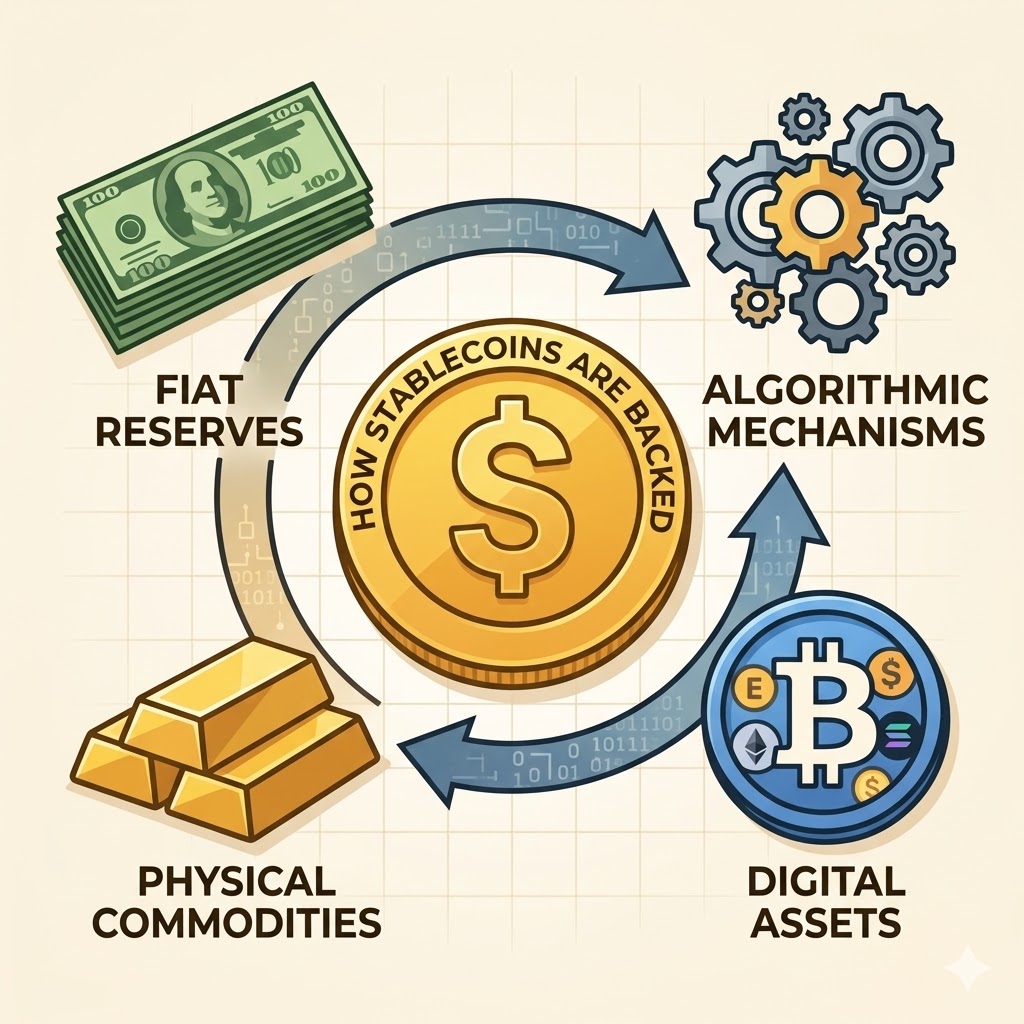
Stablecoins: It’s Time to Really Understand Them.
This is a completely different story from Bitcoin. We’ve taken a closer look at that term you keep hearing in the news.
Many of you probably just tuned out whenever the term “stablecoin” came up in the news. I did the same for a while. For quite some time, I thought it was “none of my business”—wondering how it differed from Bitcoin, why the Central Bank of Iran was suddenly using it, and what on earth it meant when people said it was affecting national economies.
But after doing some research, my perspective changed. This isn’t just about a specific country—it’s about a shift in the global asset market. Setting aside macroeconomic topics like the dollar’s hegemony and national debt for now, today I’ll focus on just one question: “What on earth is this?”
Now, let’s take a look at “What Are Stablecoins.”
What are Stablecoins?
1. Stablecoins: A 3-Sentence Summary
There’s no need for a complicated explanation. Here’s the gist of it:
Stablecoin = A digital dollar available 24/7
It’s a digital asset designed so that the price of one coin is always pegged at $1. Unlike Bitcoin, its price doesn’t fluctuate. That’s the key difference.
The most well-known examples are Tether (USDT) and USD Coin (USDC). Tether is issued by a company called “Tether,” while USDC is issued by a company called “Circle.” Both adhere to the same principle of 1 coin per $1.
If Bitcoin is an “asset held in anticipation of price appreciation,” then a stablecoin is closer to “digital cash that can be used right now.” The focus is on transactions and a means of transfer, rather than investment.
2. Why not just use dollars?
That’s a reasonable question. You might wonder why you need to convert to cryptocurrency when you already have dollars. However, there are three key differences between dollars and stablecoins.
① No bank required
All you need is a smartphone. There are absolutely no restrictions like opening an account, credit checks, or business hours. With just one wallet app, you can send and receive money from anywhere in the world.
② No borders
When sending money from your home country to another, you typically face fees, currency conversion processes, and waiting times that can take days. Using a stablecoin eliminates all these inconveniences. Transfers are completed in seconds.
③ No time constraints
It doesn’t matter if it’s the weekend, the middle of the night, or a public holiday. Even when the banking system is closed, a transfer is completed with the press of a button.
In summary, a stablecoin combines the value stability of the dollar with the portability of blockchain. It allows money to be moved in ways that were impossible with traditional dollars.
3. Where are they actually used?
While some countries with well-developed financial infrastructure may not feel the impact as much, on the other side of the globe, they are already being used as a matter of life and death.
Migrant Worker A
I have to send 3 million won in salary to my family back home every month. However, the banking system in the country where my family lives is poor—they either don’t have bank accounts at all, or even if they do, it takes several days to transfer money.
By using stablecoins, I can convert cash into USDT and send it instantly to my family’s smartphone wallet, and they can exchange it for local currency and use it right away. There are almost no fees, and there’s no need to wait.
Changes in the Local Currency Exchange Market
In some parts of developing countries, local brokers who exchange stablecoins for cash have naturally emerged. Furthermore, a system has recently appeared that allows users to link their coins to a debit card, automatically converting them into local currency when making payments at supermarkets.
In these countries, the very notion of “using coins” is fading. It has become no different from simply spending money.
Venezuela — The Front Lines of Currency Collapse
This is a country where the value of its currency has evaporated by over 99% in the span of five years. In an environment where today’s paycheck becomes worthless by tomorrow, restaurant menus list prices in USDT instead of bolivars, and rent is also paid in USDT.
The digital dollar has effectively become a lifeline.
Argentina — Receiving Part of Their Salary in Cryptocurrency
Over the past five years, the currency has lost nearly 95% of its value. Furthermore, the government has imposed restrictions on dollar purchases, making it difficult for ordinary citizens to hold dollars. As a result, an increasing number of people are receiving part of their salary in USDT from the outset. Cryptocurrency has now made its way into employment contracts.
4. Why Does This Matter?
Stablecoins aren’t just “another coin” on the market. They are fundamentally transforming the way money moves around the world.
Three scenarios where stablecoins are making a difference
• Countries and regions with limited access to banking infrastructure
• Individuals and businesses burdened by the costs and delays of international money transfers
• People who want to hold dollars due to the instability of their local currency
Billions of people worldwide fall into these three categories. While this may still feel like a “distant story,” stablecoins have already established themselves as a key variable in the global asset market.
Today’s Key Takeaways
There’s no need to overcomplicate things. Just remember one thing.
- Stablecoin = Digital dollar. Fixed price, transferable 24/7
- It can be used without banks, without borders, and without time constraints
- It has already become a means of survival in some countries
- It is a key factor that will reshape the global financial landscape