
There’s one term that has been a constant feature in cryptocurrency news since May: the CLARITY Act. However, when you actually look for an explanation, it’s often described simply as “a law establishing criteria for classifying cryptocurrencies.” But if you examine the background behind the legislation and the U.S. government’s true intentions, the story is much bigger than that.
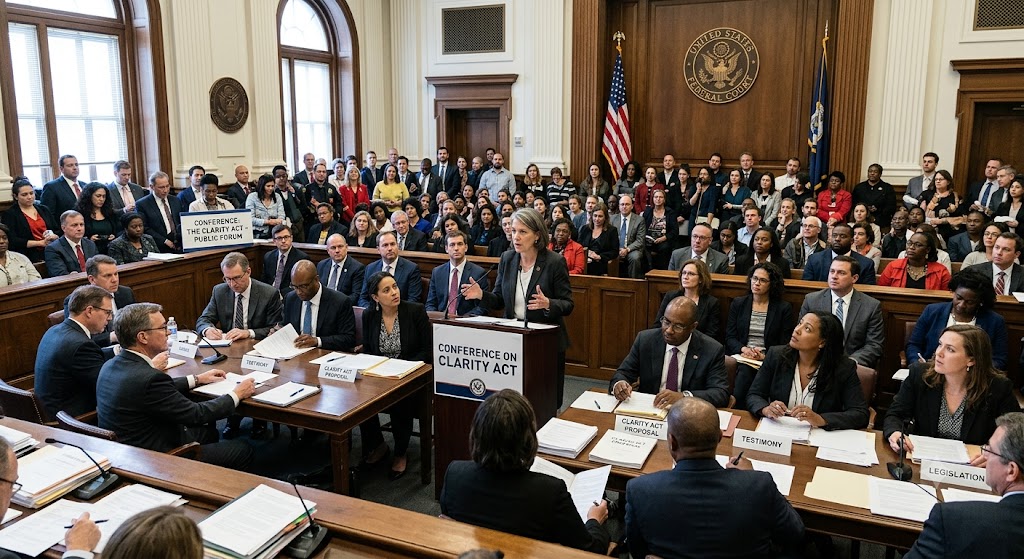
1. A question that has remained unanswered for over 10 years
Since virtual assets began to be traded in earnest in the United States, regulators have been unable to resolve one key issue: “What exactly are Bitcoin and Ethereum from a legal standpoint?”
This is not merely a philosophical question. In the U.S. financial system, the nature of an asset determines which regulatory body oversees it.
| Organization | Role | Examples of Assets Under Jurisdiction |
|---|---|---|
| SEC | Securities Regulation | Stocks, bonds, investment contracts |
| CFTC | Spot (Commodities) Regulation | Gold, crude oil, agricultural products |
Since there are no legally established criteria for determining which agency has jurisdiction over a particular cryptocurrency, there have been repeated instances where two agencies have each claimed that a specific cryptocurrency falls under their jurisdiction. Of the two, the SEC has been far more aggressive.
"Most cryptocurrencies are issued by an entity, and investors buy them in the expectation that their value will rise. This structure is essentially the same as that of stocks. Therefore, they fall under our jurisdiction."

— The SEC’s consistent position
Based on this logic, the SEC filed a series of lawsuits against major exchanges such as Coinbase and Binance. This approach involved imposing sanctions retroactively in the absence of clear legislation.
The outcome was predictable. As it became increasingly difficult to expect a stable business environment in the United States, cryptocurrency companies began relocating their headquarters to Dubai, Singapore, and Hong Kong. The perception that “it is nearly impossible to avoid litigation in the U.S.” has spread throughout the industry.
2. What the Clarity Bill Aims to Do
“Clarity” means “clarity” in English. The name of the bill itself explains its purpose. It aims to establish clear legal standards for classifying virtual assets, which have varied across different agencies until now.
The core structure of the bill is to categorize virtual assets into three types.
🟡 Digital spot assets → Under CFTC jurisdiction

Coins that operate in a decentralized manner without a specific issuer, such as Bitcoin. These are classified as commodities, like gold or crude oil.

📄 Digital securities → SEC jurisdiction

Tokens issued by specific companies that promise rights such as profit sharing. Those structurally similar to stocks fall under this category.

💵 Stablecoins for payments → Banking regulatory authorities

Coins pegged 1:1 to fiat currencies like the U.S. dollar and used as a means of payment. They are subject to a separate banking regulatory framework.
Once this classification is codified into law, companies will simply need to determine in advance which category their tokens fall under and comply with the relevant regulations. This marks the end of an era in which the SEC enforced market regulations through ex post facto litigation, and a transition to a structure where businesses can operate legally within a predictable regulatory framework.

3. Why is the U.S. pushing this legislation so hard right now?
The stated reason is to “regulate the cryptocurrency industry.” However, there are much more structural reasons behind the U.S. government’s strong push for this legislation at this particular moment. These can be summarized into four main trends.
– The Structural Limits of U.S. National Debt
The current outstanding balance of U.S. Treasury debt stands at approximately $40 trillion. The annual interest costs on this debt alone have surpassed $1 trillion, which exceeds the U.S. annual defense budget.
The problem is that a vicious cycle has already begun, in which new Treasury bonds are issued simply to pay this interest. Furthermore, the system that has sustained this structure until now—the so-called “petrodollar system”—is beginning to falter.
The petrodollar system is a structure in which the entire world is bound to settle oil transactions exclusively in U.S. dollars. For decades, the cycle in which oil-producing nations like Saudi Arabia received dollars and used them to purchase U.S. Treasury bonds has been the foundation of the dollar’s hegemony.
However, as the U.S. has begun mass-producing shale gas, its dependence on Middle Eastern oil has decreased, and Saudi Arabia is moving toward reducing its purchases of U.S. Treasury bonds. China, having observed the freezing of Russian assets, is also trending toward reducing the proportion of its dollar-denominated assets.
In conclusion, there is now open discussion within the United States itself that the existing dollar hegemony system is reaching its limits.
– Replacing the “Saudi riyal” with a stablecoin
This is where stablecoins come into play. These are digital dollars pegged 1:1 to the U.S. dollar, and under U.S. law, stablecoin issuers are required to hold the dollars they receive from users in U.S. Treasury bonds.
As the stablecoin market grows → the demand for U.S. Treasury bonds that issuers must hold automatically increases.

Currently, the amount of U.S. Treasury bonds held by stablecoin issuers ranks approximately 17th among individual nations worldwide.
The U.S. Congress has already passed the GENIUS Act, a stablecoin bill, in 2024. This law mandates that reserves be held exclusively in U.S. Treasury bonds. The Clarity Act can be viewed as the next step—an expanded version designed to incorporate the entire cryptocurrency market into this digital dollar ecosystem.
To put it simply, the design is intended to have stablecoin issuers take over the role of “U.S. Treasury bond buyer” that Saudi Arabia played during the petrodollar era.
– Competition for Global Leadership
In 2024, the European Union became the first in the world to fully implement the MiCA (Markets in Crypto-Assets) regulation. This established the first comprehensive legal framework for the cryptocurrency market. While China continues to restrict domestic cryptocurrency trading, it is simultaneously pursuing a strategy to develop Hong Kong into a global virtual asset financial hub.
From the U.S. perspective, there is a sense of urgency that if it does not act now, global digital finance standards could be reshaped around the EU or Hong Kong. The Trump administration’s decision to set July 4—the 250th anniversary of U.S. independence—as the target date for passing the bill can be understood in this context.
– The Trump Family’s Direct Financial Interest
The final factor is somewhat controversial. The Trump family directly operates a cryptocurrency company called “World Liberty Financial,” with President Trump listed as honorary co-founder and his three sons as co-founders. This company issues a dollar-pegged stablecoin called “USD1.”
The Wall Street Journal estimated that approximately 75% of the venture’s profits go to entities owned by the Trump family, amounting to roughly $500 million. If the Clarity Act is passed, the legal status of this venture would be stabilized.
For this reason, Democrats are strongly opposing the bill, stating, “We cannot agree to the bill without ethics provisions restricting the president and his family’s involvement in cryptocurrency businesses.” Regardless of the bill’s content, the conflict-of-interest controversy is acting as a variable in the bill’s legislative schedule.
4. In summary
Viewing the Clarity Act merely as a “cryptocurrency regulation bill” is only seeing half the picture. While the law’s actual function is classification and organization, underlying it is a structural U.S. strategy to redesign the wavering dollar hegemony into a digital financial system.
As the era of the petrodollar comes to an end, stablecoins will fill that void.

The Clarity Act serves as the blueprint to legally underpin that transition.
Depending on the form in which the bill is ultimately passed and how the Democrats’ demands for ethical provisions are addressed, it could have a significant impact not only on the cryptocurrency market but also on the global dollar system. This is why it is worth keeping a close eye on the progress of this bill over the coming months.
https://coinviewpoint.com/what-are-stablecoins/