
The Debate Over Bitcoin as a Safe-Haven Asset: The War Rages On
On February 28, the war began.
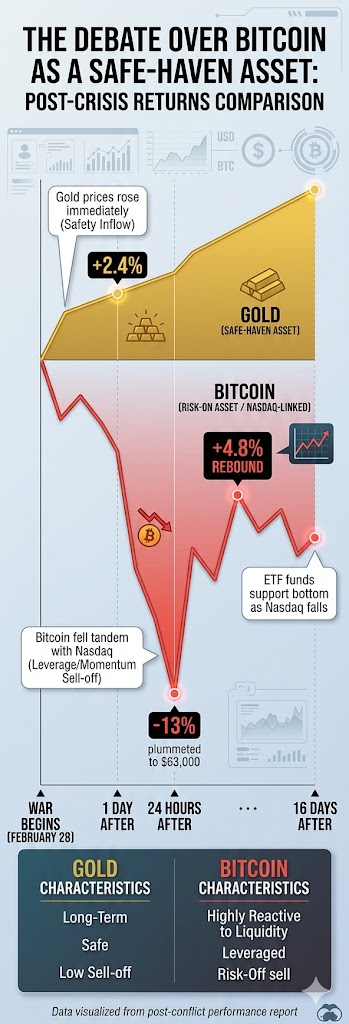
Gold prices rose immediately. Bitcoin plummeted to $63,000. Looking at this scene alone, the conclusion seems simple: “Bitcoin is not a safe-haven asset.” But the story doesn’t end there.
Those who refer to Bitcoin as “digital gold” were taken aback. Shouldn’t Bitcoin act as a safe-haven asset, just like gold, when war breaks out? But the reality was different. Is this a coincidence, or is it a structural issue?
Bitcoin vs. Gold Immediately After the War: A Performance Report by Asset Class
Looking at returns by asset class since the start of the war, trends have diverged.
Gold rose 2.4% in a single day. Bitcoin fell 13%, tracking the Nasdaq’s decline. The sharp drop continued over a 24-hour period. However, following the plunge, it rebounded by 4.8%, recovering to some extent.
What’s interesting is what happened next. Unlike the early days when Bitcoin fell in tandem with the Nasdaq, the situation changed 16 days after the war began. As institutional investors’ ETF purchases supported the bottom, Bitcoin held up relatively well even as the Nasdaq continued to decline. As of 16 days after the war began, it maintained a favorable trend compared to stocks.
However, here’s the key point: the fact that Bitcoin remained stable during the decline is entirely different from its role as a safe-haven asset during a crisis.
“Bitcoin holding its ground during a downturn is entirely different from its price rising during a crisis. The benchmark for a safe-haven asset is not ‘falling less,’ but rather ‘rising during a crisis or moving in the opposite direction of other assets.“
Three Structural Reasons Why Bitcoin Cannot Be a Safe-Haven Asset
This debate resurfaces every time a geopolitical crisis strikes. The same was true during the Russia-Ukraine war and the U.S.-Iran tensions. Immediately following these crises, Bitcoin’s price decline was far steeper than that of gold. If an asset is a “safe-haven asset,” its price decline should be contained during a crisis. That is the very definition of a safe-haven asset.
There are three structural reasons why Bitcoin fails to fulfill this role.
First, there is a structural issue in the derivatives market. The Bitcoin market is flooded with leveraged positions. When a crisis strikes, liquidations occur in a chain reaction due to liquidity issues. This is a structure that does not exist in the gold market. Unlike the gold market, which is spot-centric, Bitcoin’s futures market is much larger than its spot market. From the perspective of traditional safe-haven asset theory, this ratio itself is already a risk factor.
Second, its nature as a risk-off asset. Bitcoin is highly sensitive to short-term momentum. When a crisis strikes, investors quickly switch to risk-off mode, and Bitcoin is the first to face selling pressure. In contrast, gold is a market shaped by long-term holders over decades, so selling pressure remains relatively low even during crises.
Third, the lack of a history of trust. Gold has a history spanning thousands of years. There is a collective memory that nations trust gold and rely on its role even during wars. Bitcoin, however, has a short history of such trust. This is not merely a matter of time; it means there is low predictability regarding how market participants will behave in a crisis.
Does that mean Bitcoin is worthless?
No. Bitcoin clearly has intrinsic value.
Following this sharp decline, on-chain transaction volume surged by 700% as prices rebounded from their lows. This signals that Bitcoin is being chosen as a means to move assets across borders. In an environment where assets can be transferred across borders with just a smartphone, Bitcoin is filling a gap that traditional finance cannot reach.
The perspective changes when we view Bitcoin not as a “safe asset” but as a “decentralized, portable asset.” The defining characteristic of a safe asset is not that its price rises, but that it moves in the opposite direction of risky assets. In contrast, Bitcoin’s true strengths lie not in price stability, but in its resilience—the ability to react most quickly when liquidity flows—and its portability, allowing it to be moved instantly anywhere in the world.
Bitcoin’s true strengths lie not in price stability but in its mobility and liquidity resilience. These two qualities represent a different kind of value compared to traditional safe assets.
There are specific conditions under which Bitcoin performs well
The environment in which Bitcoin performs well is not one of “war” or “crisis,” but rather one of “liquidity.”
Bitcoin performs well when dollar liquidity is released, when the dollar weakens, and when money circulates in the market. During periods of renewed risk appetite, Bitcoin moves in tandem with the Nasdaq, and its upward momentum is often stronger than that of the Nasdaq.
The trend following this war also demonstrates this. A pattern has repeatedly emerged where ETF funds flow in and on-chain transaction volumes recover as geopolitical tensions ease somewhat. Even if the war has not completely ended, Bitcoin has reacted quickly the moment the market deems it a “manageable crisis.”
Paradoxically, this is precisely Bitcoin’s strength: it recovers quickly from crises and is the asset that reacts first when liquidity flows.
The Conclusion of the Bitcoin Safe-Haven Debate — Its Role Must Be Redefined
Bitcoin is not yet a safe-haven asset—at least not in the traditional sense.
To qualify as a safe-haven asset, it must rise during crises or move inversely to other assets. Bitcoin has not yet consistently met these criteria. The 13% plunge immediately following the recent conflict once again clearly demonstrated this limitation.
However, it would also be inaccurate to simply classify Bitcoin as a “speculative asset.” Its cross-border asset portability, its role as a decentralized financial infrastructure, and its strong upward momentum in liquid markets are unique characteristics exclusive to Bitcoin.
Bitcoin is not an “asset that loses less value,” but rather “the asset that reacts most quickly when liquidity flows.” Understanding and approaching it from this perspective is the most accurate way to view Bitcoin at this point in time.